
Artificial Intelligence (AI) is one of the fastest-growing technologies in the world today. From chatbots and voice assistants to recommendation systems and automation tools, AI is changing how businesses and people interact with technology.
Whether someone uses Netflix, Google Maps, online banking, or ecommerce apps, they are already using AI in daily life.
Businesses are increasingly exploring AI-powered applications, automation systems, and scalable digital solutions to improve efficiency and customer experiences.
What Is Artificial Intelligence?
Artificial Intelligence refers to machines or software systems that can perform tasks usually requiring human intelligence.
These tasks include:
- Learning from data
- Understanding language
- Solving problems
- Recognizing patterns
- Making decisions
Unlike traditional software that follows fixed rules, AI systems can improve over time by analyzing data and learning from user behavior.
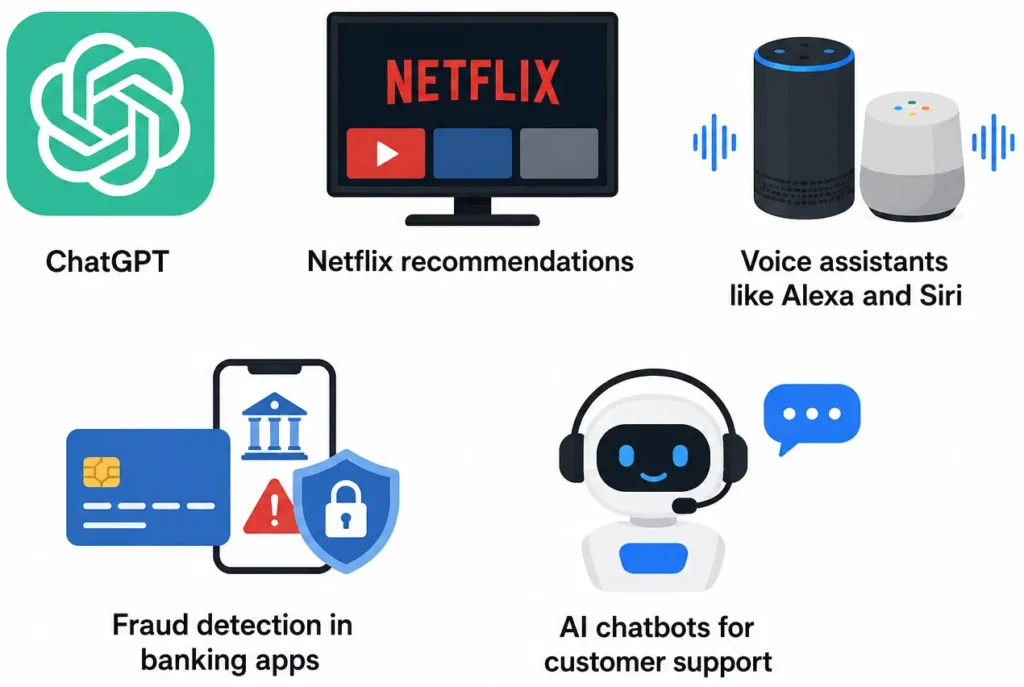
Simple Example of AI
Some common examples of AI include:
How Does AI Work?
AI works using data, algorithms, and machine learning.
The process is much simpler when broken into steps.
1. Data Collection
AI systems first collect large amounts of data such as:
- Images
- Videos
- Text
- User activity
- Customer interactions
The quality of data directly affects AI performance.
2. Pattern Recognition
After collecting data, AI analyzes it to identify patterns.
For example:
- Ecommerce platforms predict products customers may like
- Banking apps detect unusual transactions
- Streaming apps recommend content based on watch history
3. Machine Learning
Machine learning allows AI systems to improve automatically through experience.
Instead of manually updating software rules, the AI learns continuously from new data.
4. Decision Making
Once AI understands patterns, it makes decisions or predictions.
Examples include:
- Product recommendations
- Fraud alerts
- Traffic predictions
- AI chatbot responses
Types of AI
Different types of AI are used for different purposes.
Narrow AI
Narrow AI performs specific tasks.
Examples:
- Voice assistants
- Recommendation engines
- Face recognition systems
This is the most common type of AI used today.
Generative AI
Generative AI creates new content such as:
- Text
- Images
- Videos
- Code
Popular tools include AI writing assistants and AI image generators.
Predictive AI
Predictive AI analyzes past data to forecast future outcomes.
Businesses use it for:
- Customer behavior prediction
- Fraud detection
- Sales forecasting
- Marketing optimization
AI vs Machine Learning
Many people confuse AI and machine learning, but they are different.
| Technology | Meaning |
|---|---|
| AI | Broad concept of intelligent systems |
| Machine Learning | A subset of AI that learns from data |
Machine learning is one of the core technologies that powers modern AI systems.
Real-World Uses of AI
AI is already used across many industries.
AI in Ecommerce
AI helps ecommerce platforms with:
- Product recommendations
- Personalized marketing
- Dynamic pricing
AI in Banking
Banks use AI for:
- Fraud detection
- Risk analysis
- Customer support automation
AI in Healthcare
Healthcare organizations use AI for:
- Disease prediction
- Medical image analysis
- Patient management
AI in Customer Support
AI chatbots help businesses provide faster and smarter customer service.
Why Businesses Are Investing in AI
Businesses use AI because it helps improve:
- Productivity
- Automation
- Customer experience
- Decision making
- Scalability
AI also reduces repetitive manual work and operational costs.
Common Business Benefits of AI
Faster Operations
AI automates repetitive tasks and saves time.
Better Customer Experience
AI personalizes recommendations and support.
Improved Decision Making
AI analyzes large amounts of data quickly.
Scalable Automation
Businesses can grow without heavily increasing operational workload.
Challenges of AI
Although AI offers many advantages, it also comes with challenges.
Data Privacy
AI systems often require large amounts of user data, making security and compliance important.
Bias in AI
If AI learns from biased data, it can produce unfair results.
High Infrastructure Costs
Advanced AI systems may require:
- Cloud infrastructure
- Computing power
- Skilled developers
How Businesses Can Start Using AI
Businesses do not need to build massive AI systems immediately.
Start Small
Begin with simple automation tools such as:
- AI chatbots
- Email automation
- Reporting systems
Solve Real Problems
AI should focus on improving actual business operations instead of following trends.
Use Scalable AI Solutions
Businesses looking for scalable AI-powered platforms can explore for automation systems, SaaS platforms, and intelligent applications.
Key Takeaways
- AI allows machines to learn from data and make decisions.
- Machine learning helps AI systems improve over time.
- AI is widely used in ecommerce, banking, healthcare, and customer support.
- Businesses use AI to automate operations and improve customer experiences.
- AI adoption helps companies improve efficiency and scalability.
Conclusion
Artificial Intelligence is transforming modern technology and business operations. From automation and recommendation systems to predictive analytics and customer support, AI is becoming a core part of digital experiences.
As AI tools continue evolving, businesses of all sizes can use intelligent automation to improve efficiency, reduce manual work, and deliver better customer experiences.
FAQ
What is AI in simple words?
AI is technology that allows machines and software to perform tasks that normally require human intelligence.
How does AI learn?
AI learns by analyzing data and identifying patterns through machine learning algorithms.
Is AI the same as machine learning?
No. Machine learning is a subset of AI focused on learning from data.
Can small businesses use AI?
Yes. Many affordable AI tools are available for startups and small businesses.
What industries use AI the most?
Healthcare, banking, ecommerce, transportation, and customer support industries heavily use AI technologies.
Related Articles