
Which are the best Ai Agents for business in 2027
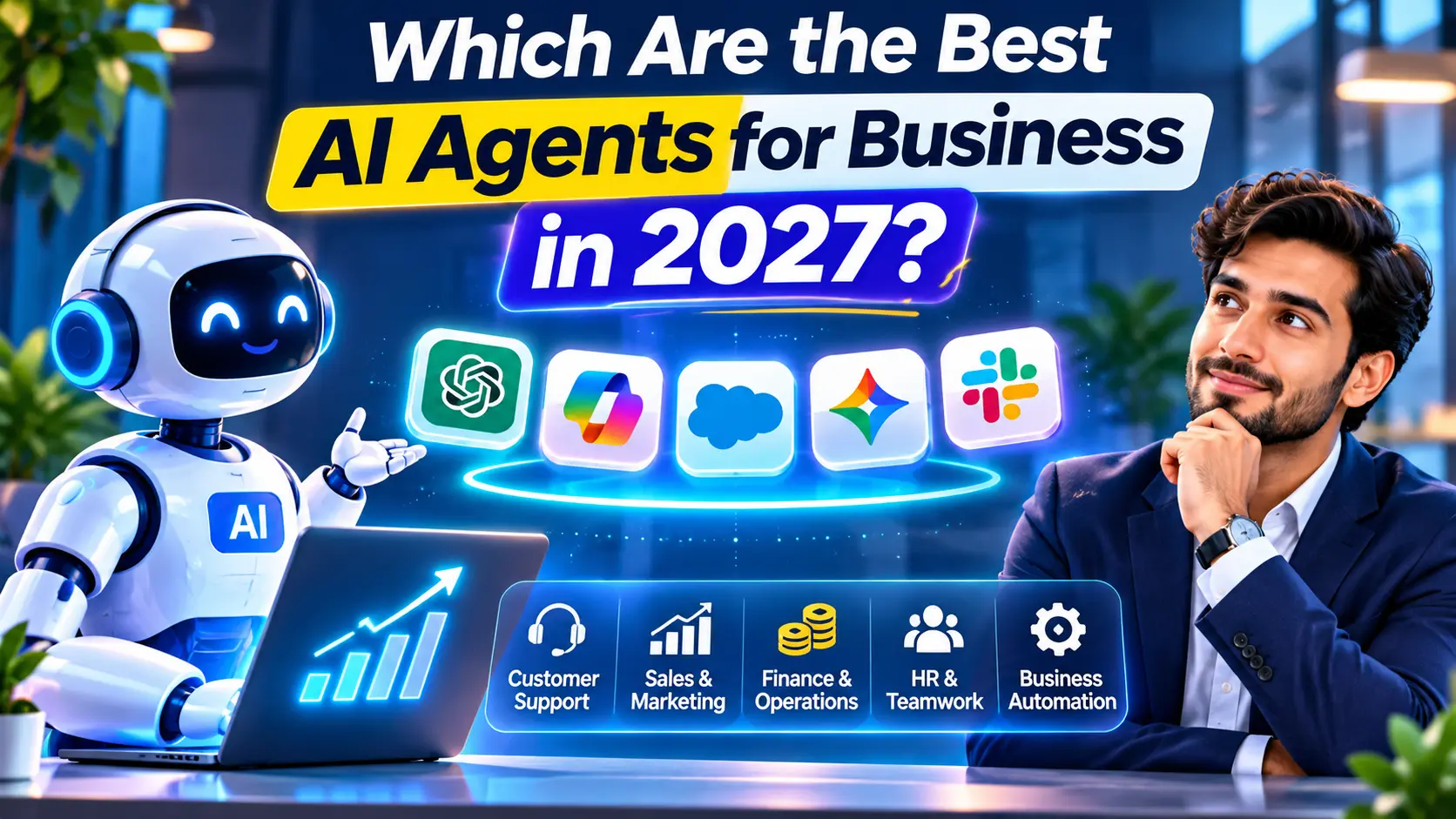
Your business may already use AI for writing emails, answering questions, or analyzing information. But what if AI could go one step further?AI agents are being designed to plan tasks, use business data, interact with software, and complete defined workflows with less human input. Microsoft and Salesforce, for example, are already developing business-focused agent platforms for sales, service, finance, HR, and other workflows.That makes AI agents an important technology to watch as businesses plan for 2027.Why This Topic MattersThe important question is no longer simply “Can AI help my business?” It is “Which AI agent can safely solve a real business problem?” As agents become more capable, businesses will need to consider integrations, cost, security, accuracy, and human oversight—not just features.What You’ll LearnWhat AI agents can do for businessesWhich options are worth consideringHow to choose the right agentCommon risks and mistakesWhat businesses should prepare for in 2027PromiseBy the end, you will have a simple framework for choosing an AI agent based on your actual business needs, rather than popularity or hype.Understanding AI Agents for BusinessAn AI agent is an AI system that can understand a goal, plan steps, use connected tools, and take actions instead of only generating an answer. A chatbot mainly responds; an agent can be designed to do part of the work.For example, a business agent could qualify a lead, update a CRM, prepare a report, or route a customer request. Modern platforms such as Salesforce Agentforce are moving toward specialized agents that can work across business data, workflows, and software.Image credit : – ChatgptWhat AI Agents Are NotThey are not completely independent employees. Agents still need clear instructions, permissions, reliable data, testing, and human oversight for important decisions.Key TermsAgent: AI that can plan and take actions.Tool: Software or API an agent can use.Workflow: A sequence of business tasks.Guardrail: A rule that limits what an agent can do.Human-in-the-loop: A person reviews or approves important actions.Myth vs RealityMythRealityAI agents can run everything aloneMost business workflows still need controls and human oversight.Every business needs many agentsOne well-designed agent can be more useful than several poorly planned ones.Problems, Challenges & Common MistakesAI agents can automate useful work, but giving an AI access to business systems also creates new risks. In 2026, cybersecurity agencies warned about issues such as excessive permissions, prompt injection, unexpected actions, data exposure, and weak human oversight.Common ProblemsAccuracy: An agent can misunderstand instructions or act on incorrect information.Security: Connecting agents to CRM, email, files, or APIs increases the potential impact of mistakes.Cost: More complex workflows can require higher usage, integrations, or paid plans.Privacy: Sensitive customer or company information needs appropriate access controls.Reliability: Agents may behave differently when tasks or inputs change.Common MistakesThe biggest mistake is giving an agent too much access too quickly. Businesses should begin with clearly defined, low-risk tasks and use limited permissions, monitoring, approval points, and the ability to stop or reverse actions.Quick ChecklistBefore deploying an agent, ask:What can it access? What can it change? Who reviews important actions? Can we stop it quickly? Can we audit what it did?How to Choose the Right AI Agent for Your BusinessThe best AI agent is not necessarily the most powerful one. It is the one that fits your workflow, software, budget, and risk level. Current business platforms are increasingly built around specific ecosystems such as Microsoft 365, Google Workspace, Salesforce, or cross-app automation.Image credit : – ChatgptLet people review important financial, legal, customer, or business decisions.Best practice: Start small, prove value, then expand. Microsoft’s 2026 research also emphasizes that organizations need to redesign workflows and define clear human responsibility as agents take on more execution.Best AI Agents for BusinessThere is no single best AI agent for every business. The right choice depends mainly on where your business data and daily work already live. Current 2026 options include general-purpose agents, CRM-focused platforms, and no-code automation tools.AI AgentBest ForKey StrengthMain LimitationMicrosoft Copilot StudioMicrosoft-based businessesAgents + workflows + Microsoft dataBest fit for Microsoft ecosystemSalesforce AgentforceSales & customer serviceCRM-grounded agentsMost useful for Salesforce usersChatGPTResearch & general business workFlexible reasoning and broad capabilitiesBusiness controls depend on plan/setupGeminiGoogle Workspace usersStrong Workspace integrationBest value inside Google ecosystemZapier AgentsCross-app automationConnects many business appsComplex workflows can increase usage costsMicrosoft Copilot Studio supports low-code agent building, business-data connections, workflows, testing, and human approval steps. Salesforce Agentforce focuses heavily on customer service, sales, HR, IT, and other business workflows.Best approach: Choose based on your workflow—not the brand name.Real-World Use CasesAI agents are most useful when they handle repetitive, multi-step work that normally requires people to move between several tools. Microsoft identifies customer service, finance, sales, HR, supply chain, and manufacturing as practical business use cases.Customer SupportAn agent can answer routine questions, summarize cases, route tickets, and escalate difficult issues. Limitation: sensitive or unusual cases may still need a human.Sales & MarketingAgents can qualify leads, summarize CRM activity, prepare outreach, and suggest next actions. Salesforce already supports these workflows through Agentforce.Finance & OperationsAgents can help process documents, identify anomalies, prepare reports, and move routine workflows forward. Human review remains important for financial decisions.HRAgents can answer internal policy questions, support onboarding, and handle routine employee requests.Small BusinessesA business can use an agent for research, customer communication, scheduling, reporting, or repetitive administration—helping small teams handle more work without automatically replacing human judgment.Key takeaway: Start with one measurable problem, prove the value, then expand.Accuracy, Privacy, Safety & Responsible AIAI agents can be useful for business, but their ability to take actions makes safety more important than with a normal chatbot. NIST reported in 2026 that AI agents introduce security challenges that require adapting traditional cybersecurity practices.Image credit : – ChatgptWhat Humans Should CheckImportant financial decisions, legal matters, sensitive customer issues, employee decisions, and irreversible actions should have human review.Key Safety RisksAgents may face prompt injection, excessive permissions, data leakage, tool misuse, or unexpected actions. OWASP recommends least-privilege access, input validation, monitoring, human approval for high-risk actions, and adversarial testing.Simple rule: Give an agent only the access it needs, test it before deployment, monitor what it does, and keep humans responsible for high-impact decisions.2027 Outlook — What Happens Next?What Is Happening NowAI agents are moving from experiments toward real business workflows, but adoption is still uneven. Gartner reported in 2026 that only 17% of organizations had deployed AI agents, while more than 60% expected to do so within two years. security, integration, and cost control—not just agent capabilities. Deloitte found that only a small share of organizations currently feel highly prepared for agentic AI.What May Happen in 2027Based on current developments, 2027 may bring:More specialized agents for sales, support, finance, and operationsGreater use of multi-agent workflowsBetter connections between agents and business softwareMore attention to agent identity, permissions, monitoring, and governanceIncreased demand for employees who can manage AI workflowsSome researchers also forecast early agent-to-agent business networks emerging in 2027, although this remains a prediction rather than a guaranteed outcome.What businesses should do now: Start with practical, low-risk workflows, build governance early, and train employees to work alongside agents.AIFastGrow’s Practical TakeAI agents can become powerful business assistants, but more automation does not automatically mean better results. The best approach is to start with a clear problem, choose an agent that fits your existing tools, and keep appropriate human checks in place.For a small business, an agent handling repetitive research, customer questions, reporting, or follow-ups may provide more practical value than building a complex multi-agent system. For larger organizations, security, permissions, governance, and integration should be considered from the beginning. Current guidance increasingly emphasizes controlled adoption rather than simply giving agents broad autonomy.AIFastGrow’s RecommendationStart small → test the workflow → measure results → improve controls → then scale.Do not choose an AI agent because it is trending. Choose it because it solves a specific business problem reliably and safely.What to Try NextIf you are new to AI agents, begin with one repetitive task and document the steps before automating it. This makes it easier to measure whether the agent is actually saving time and reducing work.Natural CTA:
Want to explore more practical ways to use AI? Explore AIFastGrow’s latest AI guides, tools, and practical workflows to find ideas you can apply to your own work.Final ThoughtAI agents could become an important part of business automation in 2027. But the best results will come from using them for clear, measurable tasks while keeping humans involved where judgment, privacy, or risk matters.FAQS1. What are AI agents for business?AI agents are AI systems that can plan tasks, use connected tools, and complete specific business workflows.2. Which AI agent is best for business?There is no single best option. Choose based on your workflow, existing software, security needs, and budget.3. Are AI agents safe for businesses?They can be used safely with limited permissions, monitoring, testing, and human approval for high-risk actions.4. Can small businesses use AI agents?Yes. Small businesses can start with customer support, research, reporting, scheduling, or repetitive administrative work.5. Will AI agents replace employees?They are more likely to automate parts of jobs and change workflows than simply replace every employee.Related Articles: